
7 AI Prompts for Teachers That Will Save Your Week
Copy-ready AI prompts for early finishers, restless classes, student conflicts, messages to families, and 15-minute review activities.
Monday, 8:15 a.m. The bell hasn’t rung yet and the list is already running through your head: something for the kids who always finish first, that pending message to a family, yet another way to explain fractions… And the week has only just started.
Teaching is an art, but it’s also a lot of management. Handling a mixed-ability class, calming a restless group, or mediating a conflict drains energy you’d rather spend on what matters most: teaching.
Artificial intelligence can be the colleague who helps clear the way. Here are 7 AI prompts for teachers that will save your week, ready to paste into ChatGPT, Gemini, or Claude. To make them easy to picture, each one comes with a teacher profile facing a common classroom situation, a way to improve the prompt, and a practical tip.
How Do You Use These AI Prompts in Your Teaching Day?
All seven prompts follow the same logic: you give the AI a role, the context of your class, and a task with a clear format. The words in square brackets are blanks to fill in, and the more specific you are, the better the answer.
| Blank | Vague version | Version that works |
|---|---|---|
[GRADE] |
“middle school” | “8th grade, 28 students aged 13-14” |
[TOPIC] |
“fractions” | “adding fractions with unlike denominators” |
[SITUATION] |
“a phone problem” | “used a phone during a test; it was taken away and returned at the end of the day” |
Three Rules Before You Paste Any Prompt
- Never include students’ personal data. No names, diagnoses, or family details that could identify anyone. Write “a 13-year-old student”, not their name. UNESCO’s guidance on generative AI lists data privacy protection among its priorities.
- The first answer is a draft. Ask for changes freely: “shorter”, “warmer tone”, “for a class with a wide range of levels”.
- You have the final say. The AI doesn’t know your class; you do.
Here is a quick map of the seven challenges we’ll solve:
| Challenge | Situation | What you get |
|---|---|---|
| 1 | Early finishers | Independent extension activities |
| 2 | A topic that isn’t landing | A fresh explanation with comprehension questions |
| 3 | A restless class | A 10-minute plan to regain attention |
| 4 | A student who won’t work | Possible causes, questions, and a short intervention |
| 5 | Conflict between students | A mediation script with a restorative ending |
| 6 | A message to a family | A clear, respectful, collaborative text |
| 7 | 15 spare minutes | A review activity with no materials |
AI Prompts for Mixed-Ability Classrooms
A class of 25 or 30 students rarely moves at the same pace. These two prompts cover both ends: the students who finish early and those who need the topic explained a different way.
Prompt 1: Extension Activities for Early Finishers
Carlos teaches secondary school and always has three or four students who finish their exercises in half the time. Soon they get bored and start distracting everyone else. Giving them “more of the same” doesn’t work, and preparing extra worksheets every day isn’t sustainable either.

Give me 5 independent extension activities for [GRADE] students who finish early, related to [TOPIC], useful and with no extra work for the teacher.The key is the last part: “no extra work for the teacher” pushes the AI toward self-checking tasks or tasks that need no new materials. If a suggestion requires printing or grading, ask it to swap that one out.
Take it further: ask it to organize the activities as a menu with three difficulty levels. Pin it to a corner of the board or your online classroom, and students can choose without interrupting you.
Carlos’s tip: giving students autonomy makes good use of time and prevents interruptions. Finishing early shouldn’t mean waiting around; it should mean learning to fly solo.
Prompt 2: Explain the Same Topic Another Way
Marta teaches math to a very diverse class. She has explained fractions twice and still sees puzzled faces. Sometimes the problem isn’t the content but the channel.
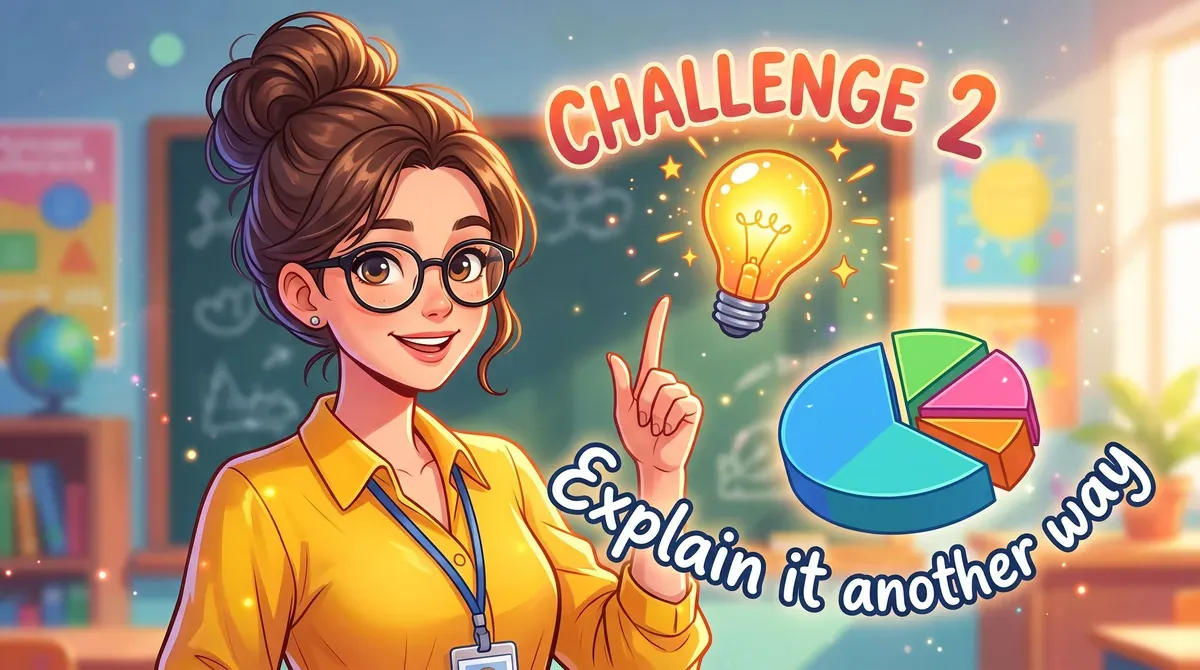
Explain [TOPIC] for [GRADE] students using simple language, an everyday example, a visual comparison, and 3 comprehension questions.This prompt asks for four different things on purpose. The everyday example connects with what students already know, like a pizza shared among friends. The visual comparison can be sketched on the board in a minute. And the comprehension questions tell you whether the message landed or you need another try.
Take it further: if the new explanation still doesn’t click, add “give me another version using soccer, music, or video games”. Every class connects with something different, and asking for alternatives costs nothing.
Marta’s tip: sometimes students don’t need more information, they need something different. Use real-world examples and check for understanding. A quick drawing is worth a thousand words.
Prompts to Restore Calm and Improve Classroom Relationships
Noise, apathy, and friction between classmates: none of it appears in any lesson plan, yet it takes up a big part of the week. Here the AI doesn’t decide for you; it helps you think with a cool head.
Prompt 3: A 10-Minute Plan for a Restless Class
Lucía teaches elementary school. After recess, the noise level in her 4th-grade class is unbearable. She knows shouting doesn’t work, since it only raises everyone’s volume, so she turns to her digital ally to bring back some harmony.
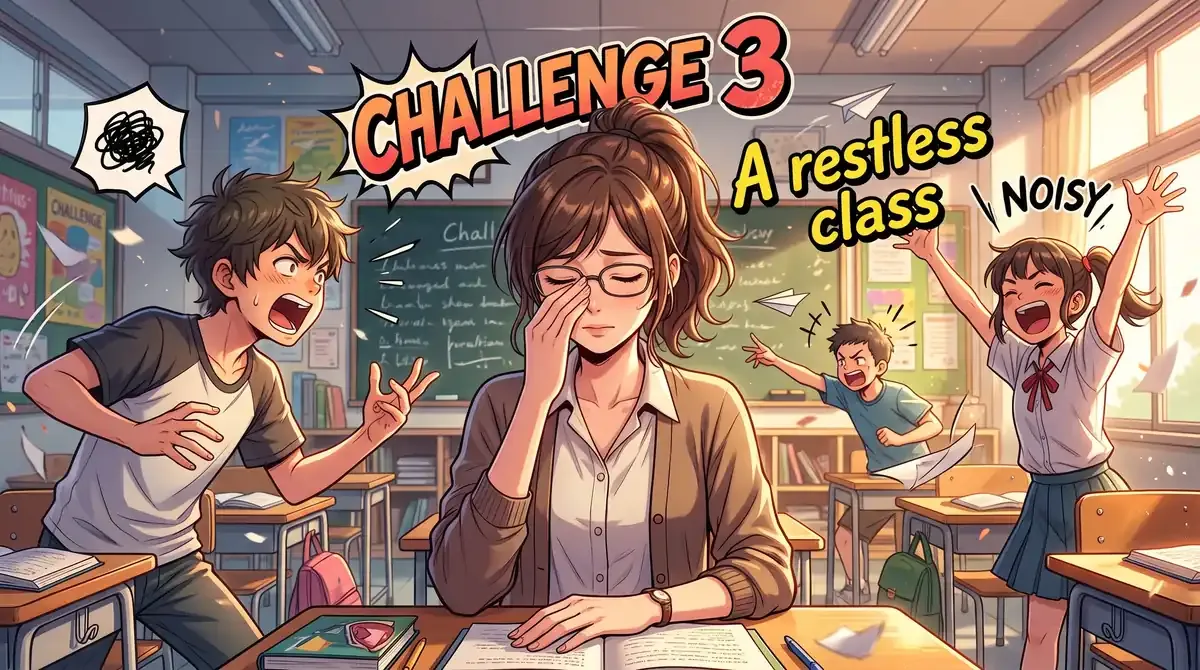
Act as a [GRADE] teacher. My class is very restless today. Design a 10-minute plan to regain their attention without shouting: an opening, a short self-regulation activity, and a return to the task.Asking for three separate phases avoids the generic “do a breathing exercise” answer. You’ll usually get an attention signal, a short breathing or movement activity, and a clear transition back to work.
Take it further: generate the plan ahead of time, not in the middle of the storm. Having two or three versions saved for your grade lets you react in seconds.
Lucía’s tip: calm first, content second. Lowering the tension is step 1, 2, and 3. Sometimes a guided breath or a quick movement game changes everything.
Prompt 4: Understanding a Student Who Won’t Work
Roberto is a homeroom teacher for 14-year-olds. One of his students has been fading over the past few weeks: no homework, no participation, one-word answers. Instead of punishing him, Roberto wants to understand what’s going on.
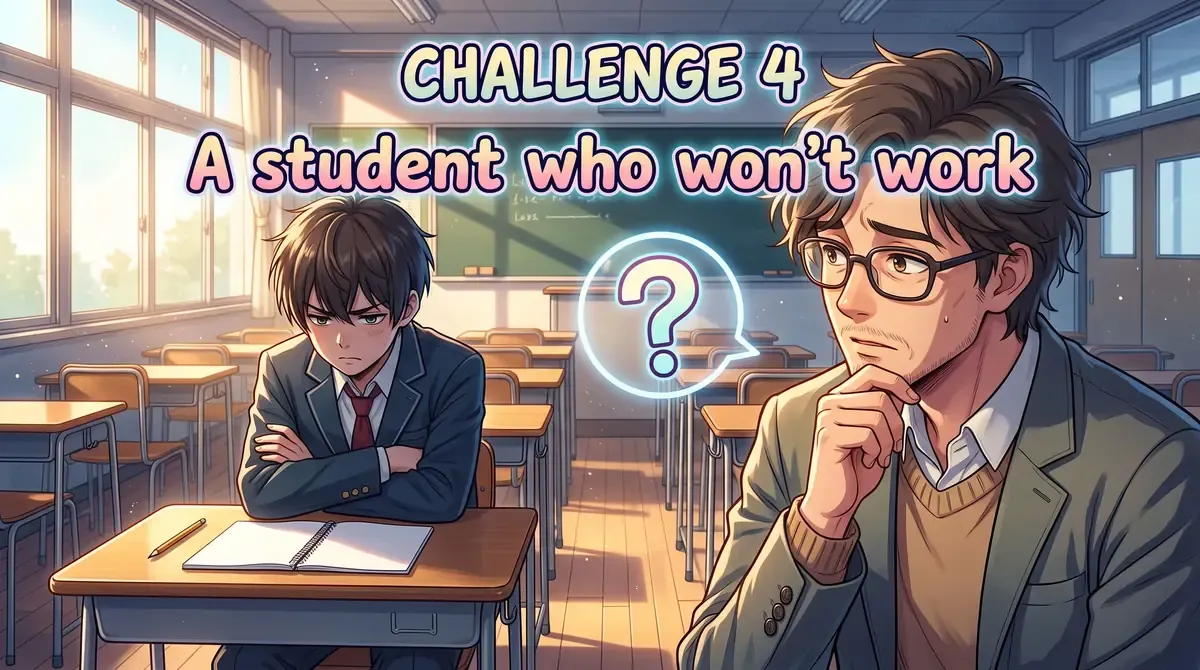
Act as a [GRADE] teacher. Help me with a student who doesn't want to work. Give me possible causes, questions to understand what's going on, and a short intervention to turn things around without getting into a power struggle.The most valuable part of the answer is the questions: they give you a script for a one-on-one conversation that doesn’t feel like an interrogation. The causes the AI suggests are hypotheses, not diagnoses. Use them to open possibilities, never to label a student.
Know the limits: if you suspect an emotional, family, or bullying issue, the AI does not replace your school counselor or your school’s protocols. Use it to prepare the conversation, not to solve the case.
Roberto’s tip: understanding first changes a lot. Empathy is the most powerful tool you have.
Prompt 5: A Script for Mediating Conflict Between Students
Elena teaches history and has just witnessed a heated argument between two students. She knows a quick punishment puts out the fire but doesn’t always fix the underlying problem, so she uses AI to prepare a mediation.
Help me mediate a conflict between two [GRADE] students. Give me neutral questions, steps to listen to both sides, and an age-appropriate restorative ending.“Neutral questions” is the key phrase. It rules out questions that look for someone to blame, like “who started it?”, and favors those that describe facts and feelings: “what happened?”, “how did you feel?”. The restorative ending can be an apology, an agreement, or a concrete commitment for next time.
Take it further: add context without personal data, such as “argument during a group project” or “comments in the class group chat”, so the questions fit what actually happened.
Elena’s tip: not every conflict can be solved in the heat of the moment. Listening to both sides and guiding the conversation toward repair is key.
Prompts to Communicate with Families and Make Every Minute Count
The last two challenges look minor, but they come up every week: writing a sensitive message and making good use of those spare minutes at the end of class.
Prompt 6: A Clear, Respectful Message to a Family
Javier teaches technology. He needs to tell a family about an incident involving a device in class, and he wants to be clear without sounding alarmist. If you’re curious about the wider debate, we looked at what the data says about banning phones in schools.
Help me write a message to a family about [SITUATION]. I want a clear, respectful, and collaborative tone, without sounding alarmist or cold.Describe the situation with facts, not judgments: what happened, when, and what action was taken. Then check the draft with three questions: does it avoid judging the student? Does it offer a way to get in touch? Does it follow your school’s communication guidelines?
Take it further: ask for two versions of the same message, a short one for the school app and a more formal one for email.
Javier’s tip: how you say it also teaches. Getting to the point with warmth and professionalism makes collaboration easier.
Prompt 7: A 15-Minute Review Activity with No Materials
Sofía teaches English. She finished the lesson earlier than planned, has 15 minutes left, and doesn’t want the class sitting idle. Luckily, she has an ace up her sleeve.
Create a 15-minute review activity on [TOPIC] for [GRADE], with almost no materials, active and easy to explain.“Easy to explain” matters more than it seems: if the instructions take five minutes, the activity loses a third of its time. Ask for the rules summarized in three sentences.
Take it further: if you want to turn that review into a reusable game, Wordwall lets you build interactive activities such as spinner wheels or quizzes in a few minutes.
Sofía’s tip: simple can work really well. It saves time, uses few materials, and gets the class moving.
What Are the Limits of AI as a Teaching Assistant?
These prompts genuinely save time, but use them with judgment. Before bringing any answer into the classroom, keep in mind that AI:
- Can make things up. Double-check dates, figures, and references before using them in class.
- Doesn’t know your class. Its suggestions stay generic until you adapt them.
- Isn’t a specialist. For bullying, mental health, or sensitive family situations, your school’s protocol comes first.
- May keep what you type. Depending on the service and your settings, conversations may be stored or used to improve the model. Always anonymize.
Used well, AI doesn’t take away your professional judgment: it gives you back the time to use it.
Use AI to Work Smarter, Not Harder
Technology isn’t here to replace you; it’s here to boost you. Carlos, Marta, Lucía, Roberto, Elena, Javier, and Sofía have different styles and challenges, but they agree on one thing: using artificial intelligence to work smarter, not harder.
Save these seven prompts in a document, use them as a starting point, and adapt them to your reality. When you have more time for yourself, you have more energy to inspire your students.
Which one will you try first? Tell us how it went in the comments, and if your students also use AI to study, share our ChatGPT study prompts with them. Have a great week, teacher!
CuriosoTech Team
Equipo editorial de CuriosoTech. Preparamos guías de tecnología y educación con fuentes oficiales y las actualizamos cuando algo cambia.
Comments