
Banning Phones in Schools: Does It Work? What PISA 2025 Says
What PISA 2025 and the latest research say about banning phones in schools, and which countries have seen good results from the policy.
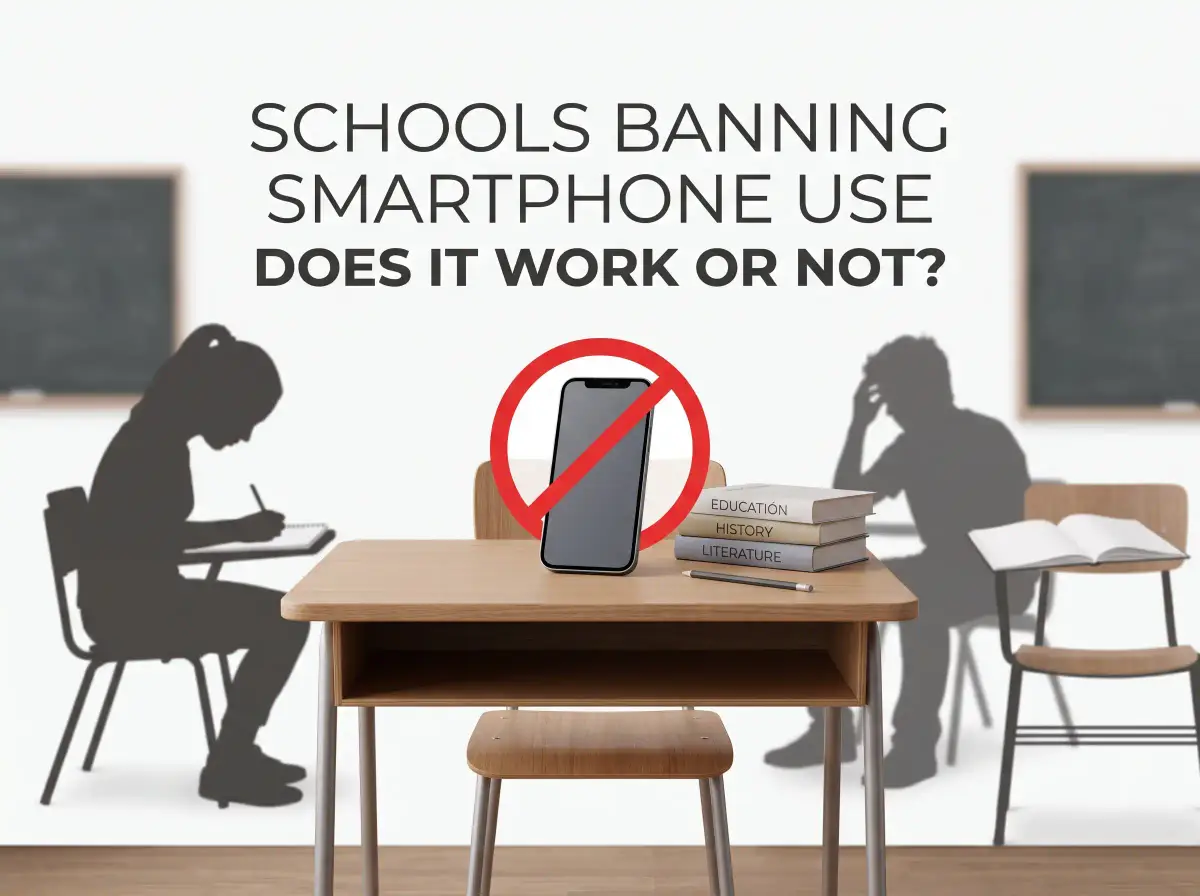
A notification chimes and thirty heads turn at once. The teacher loses the thread, the student misses the explanation and, according to the OECD, that scene has a measurable cost: up to three-quarters of a school year of learning in math.
It’s no coincidence that more than half of the world’s countries have already banned phones in schools. The uncomfortable question is a different one: does it actually work, or does it just feel good to announce?
Here we look at what PISA 2025 says, the most solid research published so far, and the countries that have already applied a ban, including what worked and what didn’t.
What Do the PISA Tests Say About Phones in the Classroom?
PISA, the OECD’s international assessment of 15-year-old students, has looked closely at digital distraction in its last two editions. The data points in the same direction.
PISA 2022: Distraction Costs Points
In the 2022 edition, the OECD found that:
- 59% of students were distracted in at least some math lessons because classmates were using digital devices
- Students who reported those distractions scored 15 points lower in math, roughly three-quarters of a school year
- 45% said they felt anxious if their phone wasn’t nearby
PISA 2025: The First Look After Widespread Bans
The PISA 2025 results, published on September 8, 2026, arrive in a worrying context: across OECD countries, reading and math fell to their lowest levels since 2000.
On phones, the report shows that on average 49% of OECD students attend schools where phones are banned on school premises. Students at those schools report fewer digital distractions in class than those at schools with more lenient rules.
Read the data carefully: PISA shows associations, not causes. Schools with bans having less distraction doesn’t on its own prove that bans raise scores. For that, you need studies that compare before and after.
Do Phone Bans Work? What the Research Shows
This is where the picture gets more nuanced. The studies agree on some things and disagree on others.
The Largest Study So Far: Less Use, Same Scores
In 2026, researchers from Stanford, Duke, the University of Michigan and the University of Pennsylvania published the broadest analysis to date through the National Bureau of Economic Research, with data from about 4,600 schools in the United States.
One result was clear: at schools with a full-day ban, the share of students using phones in class for non-academic purposes dropped from 61% to 13%. Teachers also reported fewer distractions.
But academically, the average effect on test scores was close to zero, and the authors found little evidence of improvements in attendance or online bullying.
Norway: Strong Benefits, Mostly for Girls
Economist Sara Abrahamsson analyzed more than 400 Norwegian middle schools and found notable effects, though concentrated in one group:
- Girls improved their grades and their results on externally graded math exams
- Their visits to mental health specialists dropped by about 60%
- The bullying they reported fell by around 46%
The key detail: the effects only appeared among girls exposed to the ban for at least two years, and were much smaller for boys.
United Kingdom: Phone Use Shifts, It Doesn’t Disappear
A University of Birmingham study published in 2025 compared schools with strict and lenient rules and found no clear differences in well-being or grades. Another British finding helps explain why: students at schools with bans used their phones less during the school day but made up for that time outside school.
Which Countries Have Banned Phones With Good Results?
According to UNESCO, as of March 2026 there are 114 education systems with a national ban, or 58% of countries. In 2023 it was just 24%.
| Country | Since | Scope | Reported results |
|---|---|---|---|
| France | 2018 | Primary and lower secondary | Pioneer of the comprehensive ban; a model for Europe |
| Norway | School by school (2010s) | Middle school | Better grades, less bullying and fewer mental health visits among girls |
| Netherlands | 2024 | Secondary, then primary | 75% of schools report better concentration |
| Denmark | Announced in 2026 | Public and independent schools | 65% of students already studied phone-free before the law |
| United Arab Emirates | In force | National | 90% of students in phone-free schools, per PISA 2025 |
Netherlands: The Best-Documented Case in Europe
The Dutch ban started in January 2024 for secondary schools and was extended to primary schools in the 2024-2025 school year. A government-commissioned evaluation published in 2025 surveyed 317 schools:
- Three out of four noticed an improvement in students’ concentration
- Almost two-thirds saw a better social climate
- One-third perceived better academic results
These are perceptions from school leaders, not test score measurements, but they show a change that the schools themselves value.
Denmark: The Response After PISA 2025
Just two days after PISA 2025 was published, the Danish government announced a plan for a total ban on phones and personal screens in public and independent schools. The country was already ahead: 65% of its students attended phone-free schools, compared with the OECD average of 49%.
Fun fact: the Danish announcement fueled the debate in other European countries, where some politicians used the PISA results to push for similar measures.
Latin America Is Joining the Ban Too
The region came to the debate later, but in a short time several countries moved from recommendations to law:
- Brazil: federal ban since early 2025, in class and during recess, for primary and secondary schools
- Chile: law passed in December 2025, in force since March 2026 in public and private schools, with exceptions for special educational needs, emergencies or medical conditions
- Mexico: restriction in primary and secondary schools starting November 3, 2026; students can bring their phones but must keep them put away during class and recess
- Colombia, Paraguay and Peru: have rules regulating use, though without a full ban
The context makes the issue urgent. In PISA 2025, the Latin American average fell 11 points in reading and 4 in math compared with 2022. Costa Rica, El Salvador and Uruguay were among the few systems in the world that improved.
It’s still too early to attribute changes to these bans: most are so recent that they weren’t reflected in the latest assessment.
What a Ban Doesn’t Fix on Its Own
Being honest with the evidence means acknowledging its limits. These are the points researchers raise most often:
- It’s not a magic fix for grades: the largest study found no average short-term improvement in test scores
- Effects take time: in Norway they only appeared after two years of exposure
- Use shifts elsewhere: if phones leave the school, they can gain hours at home
- Enforcement matters: a full ban with lockers or locked pouches doesn’t work the same as a rule nobody enforces
- Educational technology is still valuable: banning personal phones doesn’t mean removing technology from the classroom
That last point matters. Tools designed for learning, like PhET’s interactive simulations or Wordwall’s learning games, show that screens used well add value. The problem isn’t the device, it’s distraction without purpose.
So, Is Banning Phones in Schools Worth It?
The evidence points to one clear result and one that’s still open. The clear part: bans reduce phone use in class and distractions, and in some cases improve school climate and well-being, especially for girls. The open part: their direct effect on test scores hasn’t yet been shown consistently.
A phone ban works better as a starting point than as a complete solution. Combined with good teaching practices, digital education and rules that are actually enforced, it can give classrooms back something PISA shows is being lost: attention.
Has your school already banned phones? Tell us in the comments whether you’ve noticed a difference, and if you’re a teacher, check out our Liveworksheets guide to bring purposeful technology into your lessons.
CuriosoTech Team
Equipo editorial de CuriosoTech. Preparamos guías de tecnología y educación con fuentes oficiales y las actualizamos cuando algo cambia.
Comments