
6 Chinese AI Tools That Feel Like Magic (and Are Free)
Discover 6 Chinese AI tools for coding, generating video, and automating complex tasks. Most of them are free and barely anyone knows about them.
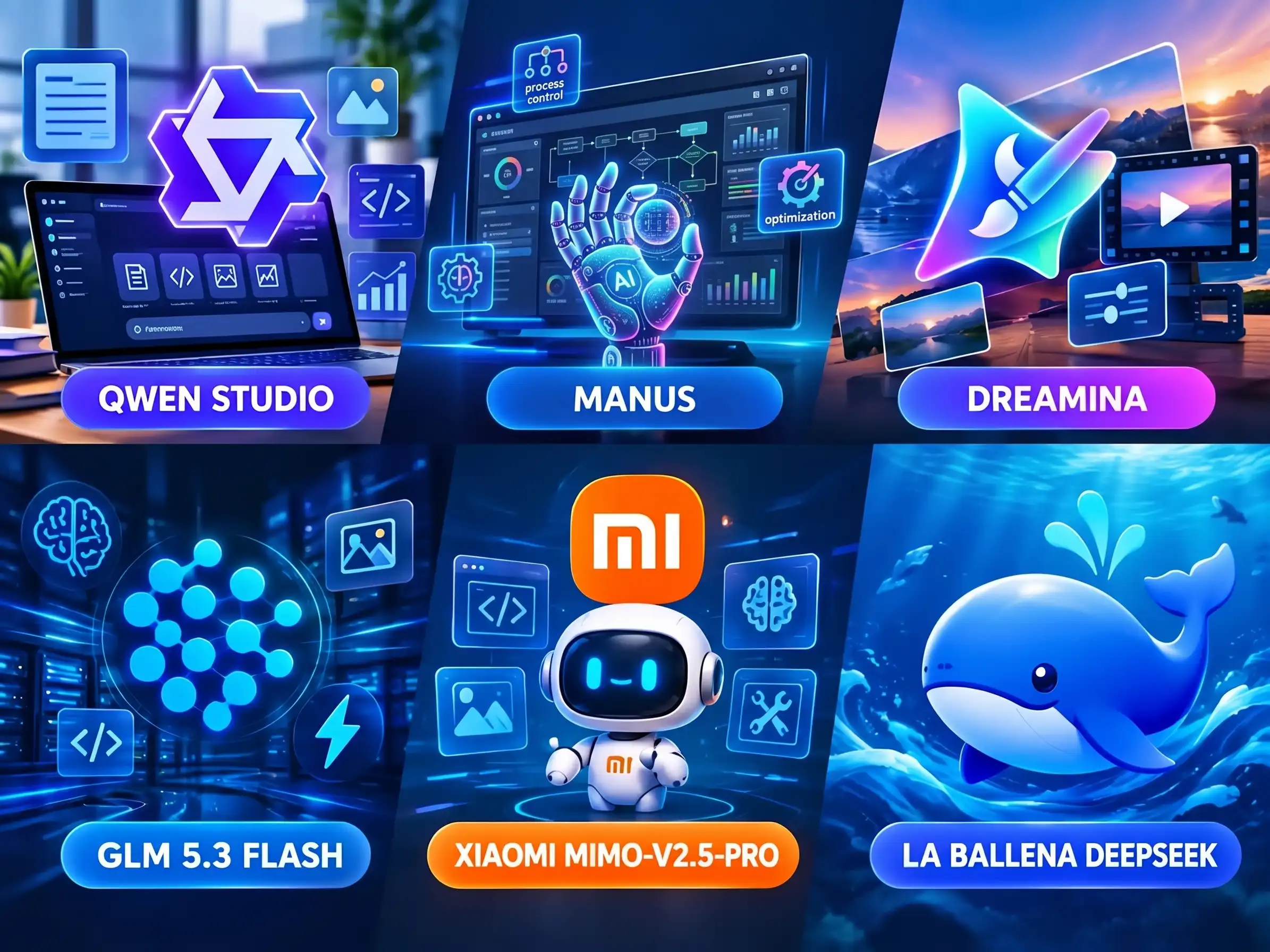
While everyone argues over whether a ChatGPT Plus subscription is worth it, a handful of Chinese labs have spent months shipping models that match or beat the big Western names — almost always for free, with no waitlist attached.
The problem is that hardly anyone outside a few niche circles knows about them. They don’t show up in the “best AI of 2026” viral rankings, yet plenty of developers, designers, and automation-minded professionals already use them daily.
Here are six of those tools: what they do, who built them, and why they deserve a spot on your AI shortlist.
1. Qwen Studio: Alibaba’s All-in-One Suite for Writing, Research, and Code
Qwen Studio is Alibaba’s AI platform, and one of the most complete to come out of China. From a single interface you can write, research a topic, analyze files, generate images, and code — switching between the different models in the Qwen family depending on the task.
What’s interesting is that it doesn’t lock you into one model for everything. Need deep reasoning? Switch to a heavier variant. Need speed for a simple task? Switch to a lighter one — all without leaving the same chat window.
- Qwen 3.8 Max: the suite’s flagship model, available 100% free
- Built-in image generation with no external tools required
- Document analysis (PDF, Excel, Word) directly inside the chat
- Multi-step task execution without losing context along the way
Key fact: unlike many AI suites that gate their best features behind a paid tier, Qwen 3.8 Max is free to use, making it a genuine alternative to ChatGPT Plus if you don’t want another monthly subscription.
You can try it directly at chat.qwen.ai — no credit card required to get started.
2. Manus: The Autonomous Agent That Plans and Executes Tasks for You
Manus isn’t just another chatbot — it’s an autonomous AI agent designed to plan, execute, and complete complex tasks for you from start to finish, without you having to supervise every intermediate step.
The difference from a conventional assistant is the approach: instead of asking for a snippet of text or code, you give it a full goal — for example, “research three suppliers, compare prices in a table, and write me a recommendation” — and Manus breaks the task into steps, browses the web, uses external tools, and delivers a finished result.
Who Manus makes sense for:
- Anyone who needs to delegate multi-step tasks (research, writing, analysis) without micromanaging every prompt
- Professionals who want to automate repetitive workflows, like generating reports or comparing options
- Small teams that don’t have time to manually chain together several different AI tools
If you’ve already worked with agentic assistants like Kimi, Manus takes it a step further: it doesn’t just research — it also executes the entire task without manual intervention at each stage.
You can start using it at manus.im/app.
3. Dreamina: Generate Images and Video with AI from ByteDance
Dreamina, built by ByteDance (the company behind TikTok and CapCut), is focused entirely on visual creation. With text commands you can generate images, produce short videos, edit existing scenes, or turn a static image into an animated sequence.
Its edge over other image-to-video tools is iteration speed: instead of waiting minutes for each render, the workflow is built for testing variations quickly and keeping the one that works.
Where Dreamina shines:
| You need | How Dreamina helps |
|---|---|
| Turn a photo into a short video | Converts an image into an animated clip from a prompt |
| Generate art for social media | Creates images from scratch with a consistent style |
| Edit a scene without Photoshop | Modifies elements in the image via text instructions |
| Produce content fast for TikTok/Reels | Exports clips ready to publish |
If you already work with infographics or animated content for social media, this tool pairs well with what we covered in our guide on animating infographics with AI — the difference is that Dreamina is built from the ground up for video, not just for animating an existing piece.
You can try it at dreamina.capcut.com.
4. GLM 5.3 Flash: Zhipu AI’s Lightweight Multimodal Model
GLM 5.3 Flash, from Zhipu AI, tackles a real problem: large models tend to be slow and expensive to run. Zhipu’s solution was to build a model with 320 billion total parameters, but that only activates 18 billion per task.
In practical terms, this means GLM 5.3 Flash keeps high performance on coding, reasoning, and image understanding, while consuming far fewer computational resources than a model that activates all its parameters at once — which translates into faster responses and cheaper scaling.
Why does the “mixture of experts” architecture matter? Instead of using the entire neural network for every query, the model activates only the specialized parts relevant to that specific task. It’s the same philosophy behind other efficient models that gained ground in 2026.
GLM 5.3 Flash is a solid pick if you need speed without giving up multimodal capability entirely, especially for agent workflows that require many calls in a row.
You can try it at chat.z.ai.
5. Xiaomi MiMo-V2.5-Pro: Built for Long-Horizon Software Engineering
Xiaomi isn’t the first name that comes to mind when you think of language models, but MiMo-V2.5-Pro is its most serious attempt yet at reasoning, coding, and AI agents.
The numbers are substantial: 1.02 trillion total parameters, with only 42 billion active per token, and a context window of up to 1 million tokens. It was designed specifically for long-running tasks — the kind of work where an agent needs to execute thousands of tool calls in a row without losing coherence.
What That Much Context Is Actually Good For
A million tokens of context isn’t a vanity number. In practice it allows you to:
- Keep the full state of a large software project loaded throughout an entire work session
- Run agents that chain hundreds of actions without “forgetting” instructions given at the start
- Process entire codebases in a single conversation instead of splitting them into pieces
It’s a tool aimed at a specific technical profile: developers and teams that need a reliable agent for long tasks, more than a day-to-day conversational assistant.
You can access it at aistudio.xiaomimimo.com.
6. DeepSeek: The Chinese AI Already Competing Directly with ChatGPT and Claude
If there’s one name on this list you probably already recognize, it’s DeepSeek. It’s one of the fastest-growing Chinese AI companies globally and, today, one of the main alternatives to ChatGPT and Claude outside the United States.
Its latest model, DeepSeek V4.1 Flash, combines advanced reasoning, coding, tool use, and image understanding, with a clear focus on response speed — something you notice especially when using it for agent tasks that require several iterations in a row.
What keeps DeepSeek relevant against the competition:
- Free chat access with no aggressive restrictions through its official website
- A solid balance between reasoning and speed, without forcing you to choose one over the other
- Frequent updates that keep it competitive against releases from OpenAI, Google, and Anthropic
You can try it with a quick sign-up at chat.deepseek.com.
Which of These AI Tools Should You Try First?
They don’t all solve the same problem, so the right pick depends on what you actually need to do:
| If you need… | Try first |
|---|---|
| A free all-in-one suite | Qwen Studio |
| Automating complex tasks start to finish | Manus |
| Fast video and image creation | Dreamina |
| Speed and low cost for agents | GLM 5.3 Flash |
| Very long software projects | Xiaomi MiMo-V2.5-Pro |
| A direct ChatGPT replacement | DeepSeek |
What to Know Before Using Chinese AI Tools (Privacy and Language)
Being upfront about the limitations matters as much as highlighting the advantages:
- Data policies: since these are Chinese companies, it’s worth reviewing their privacy terms before uploading sensitive or work-related information, just as you would with any tool that processes your data on servers outside your country.
- English- or Chinese-only interfaces: several of these platforms aren’t fully localized into other languages, though most understand and respond perfectly well in English.
- Uneven availability: some advanced features (like running open-source models locally) require powerful hardware that not everyone has on hand.
- Fast-moving landscape: this is a sector that changes quickly — names, versions, and free-tier limits can shift from one month to the next.
None of this invalidates the value of these tools, but it’s worth keeping in mind before building them into a serious workflow.
Is It Worth Switching to Chinese AI Tools?
This isn’t about abandoning ChatGPT, Gemini, or Claude — it’s about having alternatives ready when price, availability, or a specific feature calls for one. Qwen Studio and DeepSeek cover general free use well; Manus and Xiaomi MiMo-V2.5-Pro are built to sustain long, complex tasks without constant supervision; Dreamina and GLM 5.3 Flash solve more specific needs around visual creation and efficiency.
What all six share is worth noting: none of them forces you to pay upfront just to find out if it works for you.
Have you already tried any of these tools? Tell us in the comments which one surprised you the most — and if you want to explore more generative AI options for visual content, don’t miss our guide on restoring photos with AI.
CuriosoTech Team
Equipo editorial de CuriosoTech. Apasionados por la tecnología y la educación accesible.